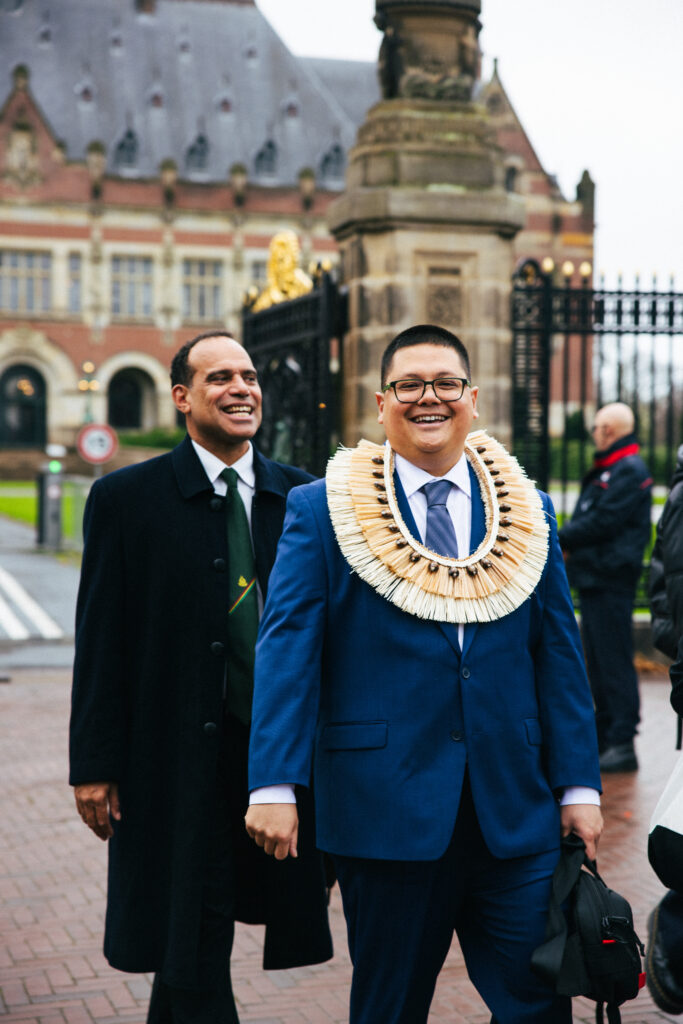
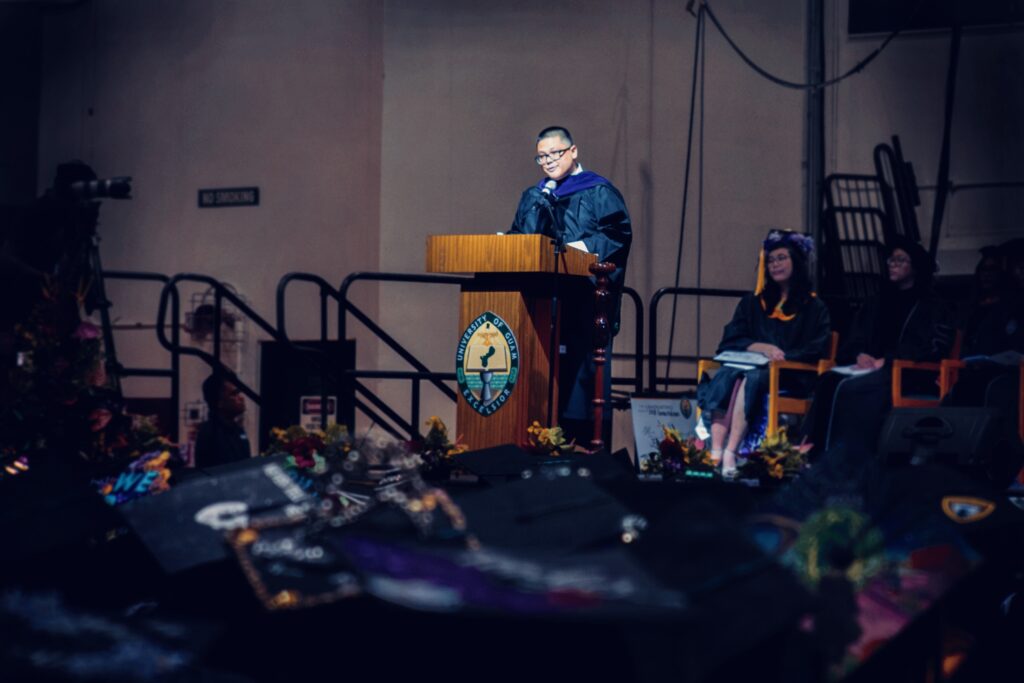
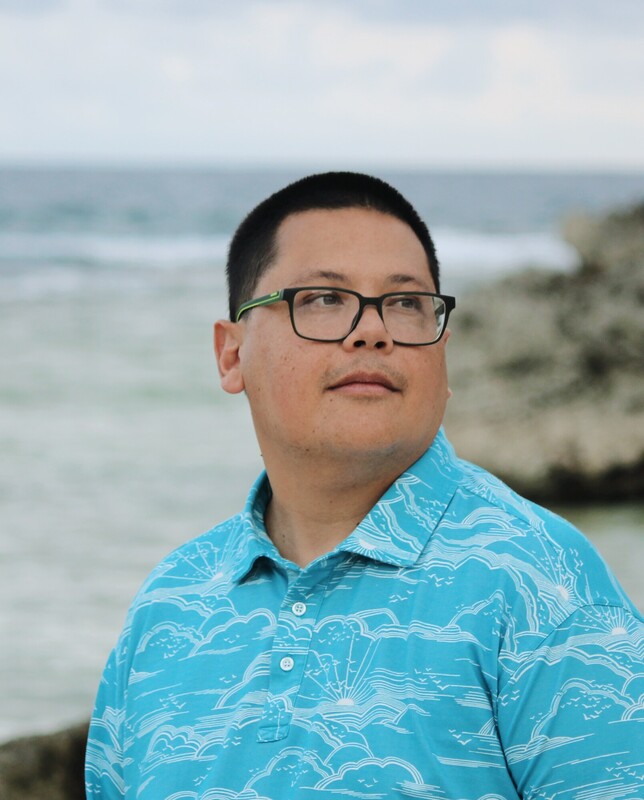
Julian Aguon standing outside the peace palace.

Julian Aguon

Guam

Place of Birth: Guam

Date of Birth: May 28, 1982

Education: Simon Sanchez High School (Guam), Gonzaga University (Washington), William S. Richardson School of Law (Hawaii)

Instagram: @julianaguon

Facebook: Julian Aguon

Contact us for interview requests and further information.

,

Awarded

Julian Aguon

“For carrying the call for climate justice to the world’s highest court, turning survival into a matter of rights and climate action into a legal responsibility.”

Julian Aguon is a Chamoru human rights lawyer and writer from Guam, who has dedicated his life to defending the rights of Indigenous Peoples, advocating for their self-determination, and pursuing climate justice. His home, the Pacific, is among the regions most severely affected by the climate crisis. He played a central role in securing the 2025 International Court of Justice advisory opinion, which declared that states have binding obligations to address climate change, a watershed milestone in international law.

He shares the Right Livelihood Award with Pacific Islands Students Fighting Climate Change (PISFCC). While the student-led movement mobilised community support and international solidarity, Aguon’s firm, Blue Ocean Law, provided the legal strategy that carried their demand into the courtroom of the world’s highest tribunal in a profoundly collective and intergenerational campaign.

Aguon’s work spans from the courtroom to the written word. At home, he has fought the militarisation of Guam, exposing the destruction of ancestral lands for US military bases while defending his people’s right to self-determination. As an acclaimed author and Pulitzer Prize finalist, his books and articles, including his essay collection No Country for Eight-Spot Butterflies, etch both the beauty and the struggle of Pacific peoples onto the world’s imagination.

Through legal advocacy and storytelling, he has become a leading voice of Pacific resistance and a symbol of hope for a just and sustainable future.

When the Court finally spoke, it felt like the world shifted. The Court was right on the law and also on the right side of history. Its ruling heralded a new era of climate accountability.

Julian Aguon

Biography

Aguon, a Chamoru human rights lawyer and acclaimed author from Guam, confronts the dual crises of climate change and continued colonialism threatening Pacific Island peoples.

Through both courtroom advocacy and powerful writing, he has reshaped international climate accountability, empowered Indigenous communities and become a global voice of resilience in the fight for dignity, justice and sustainability for all.

Colonial Scars, Climate Storms

The Pacific Islands are among the places most exposed to the accelerating climate emergency. Rising seas, intensifying storms and ecological collapse threaten not just lives and livelihoods but the survival of entire cultures. This environmental upheaval comes atop a centuries-long legacy of colonisation, militarisation and nuclear testing that has already scarred Pacific lands and seas.

On Guam, an unincorporated US territory seized in 1898, Indigenous Chamorus — the island’s original inhabitants who have lived there since time immemorial — remain denied their right to self-determination. Large swathes of their ancestral lands have been taken, much of it converted into sprawling US military bases that continue to pollute the island. Decades of environmental contamination have left Chamorus with what Aguón, drawing on findings from the Guam Cancer Registry, describes as some of the highest cancer rates in the Pacific, “a burden that has touched nearly every family.

For islanders, the fight for climate justice cannot be separated from struggles against dispossession and oppression. As Aguon has written, “We have survived the ravages of extractive industry and the experiments of nuclear powers. We have information vital to recovering the planet’s life-support systems”. It is this intersection, climate change as both an environmental and a human rights crisis, that has defined his career.

From Loss to Law

Born in 1982 on Guam, Aguon grew up witnessing firsthand the consequences of militarisation and colonial neglect. His father, exposed to radiation-contaminated ships brought to Guam from US nuclear tests in the Marshall Islands, died of cancer. These personal losses, combined with the systemic dispossession of his people, propelled Aguon into a legal career. At the University of Hawai‘i at Mānoa, he trained as a lawyer specialising in self-determination and Indigenous rights, before founding Blue Ocean Law in 2014, the Pacific’s first international human rights law firm.

Building the Pacific’s First Human Rights Law Firm

From its base in Guam, Blue Ocean Law became the first and only human rights law firm in the Pacific dedicated to centring Indigenous voices in international advocacy. It quickly grew into a hub of Indigenous and environmental work across Oceania, partnering with communities in Fiji and Papua New Guinea to resist deep-sea mining, and publishing pioneering work on how to regulate seabed resources in ways that safeguard people and the planet.

Distinctively, the firm bridges grassroots testimony with global legal strategy, ensuring community experiences shape international proceedings. Aguon represented Chamoru groups in cases challenging US militarisation, including litigation against the clearing of limestone forests for firing ranges, a habitat critical to Guam’s endangered eight-spot butterfly. He framed the butterfly, which undergoes one more metamorphosis than other butterfly species, as a symbol of Chamoru resilience in the face of repeated upheavals.

Reflecting on his commitment to his homeland, Aguon has said:

“For me, self-determination is not an abstraction. It’s about protecting the land and waters that raised us, so our people can live full, healthy lives.”

In US federal court case Davis v. Guam, a non-Chamoru resident challenged a planned referendum on Guam’s political status, arguing it was unconstitutional to limit the vote to “Native Inhabitants of Guam.” Aguon represented Guam’s native people, defending their right to determine their political future under international standards of decolonisation. Although the US courts struck down Guam’s law that would have allowed only Native Inhabitants to vote on the island’s political status, his arguments helped galvanise global advocacy at the UN and beyond.

“It’s not always or only about fighting the fights you can win. Sometimes it’s simply about fighting the fights that need fighting,” he said.

When the Pacific Spoke and the World Listened

Aguon and his team played a central role alongside Pacific and international allies in the campaign for an International Court of Justice (ICJ) advisory opinion on climate change. Careful not to claim sole credit, he has emphasised that the campaign was deeply collaborative, with Pacific states, youth movements and civil society playing indispensable roles. His team at Blue Ocean Law, however, was instrumental in shaping the legal questions and supporting Vanuatu’s successful push to bring the matter before the UN General Assembly in 2023, which then referred the question to the Court.

Over five years, his small firm coordinated with blocs representing more than 79 vulnerable states, drafted submissions, and helped small island developing states and other climate vulnerable countries to argue that wrecking the climate system violates both human rights and customary international law. In July 2025, the ICJ issued its long-awaited opinion — the most progressive climate ruling ever by the world’s highest court — affirming that states have binding obligations to mitigate and adapt, cease harmful practices such as fossil fuel subsidies, and provide reparations for climate harm.

This opinion marked a true before-and-after moment, transforming international climate law from voluntary pledges to binding duties. It was a David versus Goliath breakthrough that proved even small island nations could change the course of history.

An Alliance that Made World History

In 2025, Aguon shares the Right Livelihood Award with Pacific Islands Students Fighting Climate Change (PISFCC), the youth-led Pacific movement that transformed a classroom idea into a global campaign for climate accountability at the ICJ. While PISFCC and the World Youth for Climate Justice (WY4CJ) galvanised students, communities and governments behind the call, Aguon and his team shaped the legal pathway that ensured their demand was heard before the world’s highest court. Together, they combined the fire of youth-led mobilisation with the rigour of Indigenous legal advocacy, placing the Pacific at the centre of international legal history.

How a Butterfly Became a Symbol of Resistance

Through both law and narrative, Aguon has emerged as one of the Pacific’s most powerful public voices. His 2021 Atlantic essay To Hell With Drowning was named a finalist for the Pulitzer Prize in Commentary, praised for bringing Indigenous perspectives into the global climate debate. His book No Country for Eight-Spot Butterflies weaves memoir and manifesto, offering lyrical testimony on loss, endurance and the imperative of decolonisation.

The eight-spot butterfly, native to Guam, is endangered by the clearing of limestone forests for U.S. military installations, including live-fire training ranges. For Aguon, its unusual life cycle, enduring one more stage of transformation than most other butterflies, makes it a profound metaphor for Chamoru resilience. In his book, Aguon writes about the struggle to save this butterfly from the edge of extinction: 

“We are not naïve. We know we might not win. But we also know we owe it to her to fight at least as hard as she does. Though far less famous than her sister, the monarch butterfly, she is just as strong, if not stronger. Whereas her sister goes through five larval instars, she goes through six. It stops my blood to think about that. She has to die six times in order to live.”

“This legacy of endurance is ours, too: a reminder that we can withstand even this,” he said.

What began as a legal case to protect its habitat has since blossomed into something larger. After he began writing about the butterfly, Aguon was inundated with messages from around the world: strangers sharing how the story moved them, families telling him they had planted trees for the butterfly, young people tattooing its image on their skin, artists painting it into their work. The eight-spot butterfly, once nearly invisible, became an emblem of survival, grief and defiance: a living thread binding personal memory to the broader struggle for collective liberation.

Celebrate courage.
Shape what comes next.

Meet the change-makers transforming our world — and help us find the next ones!